The Optionality Scorecard: Are you ready to go independent?
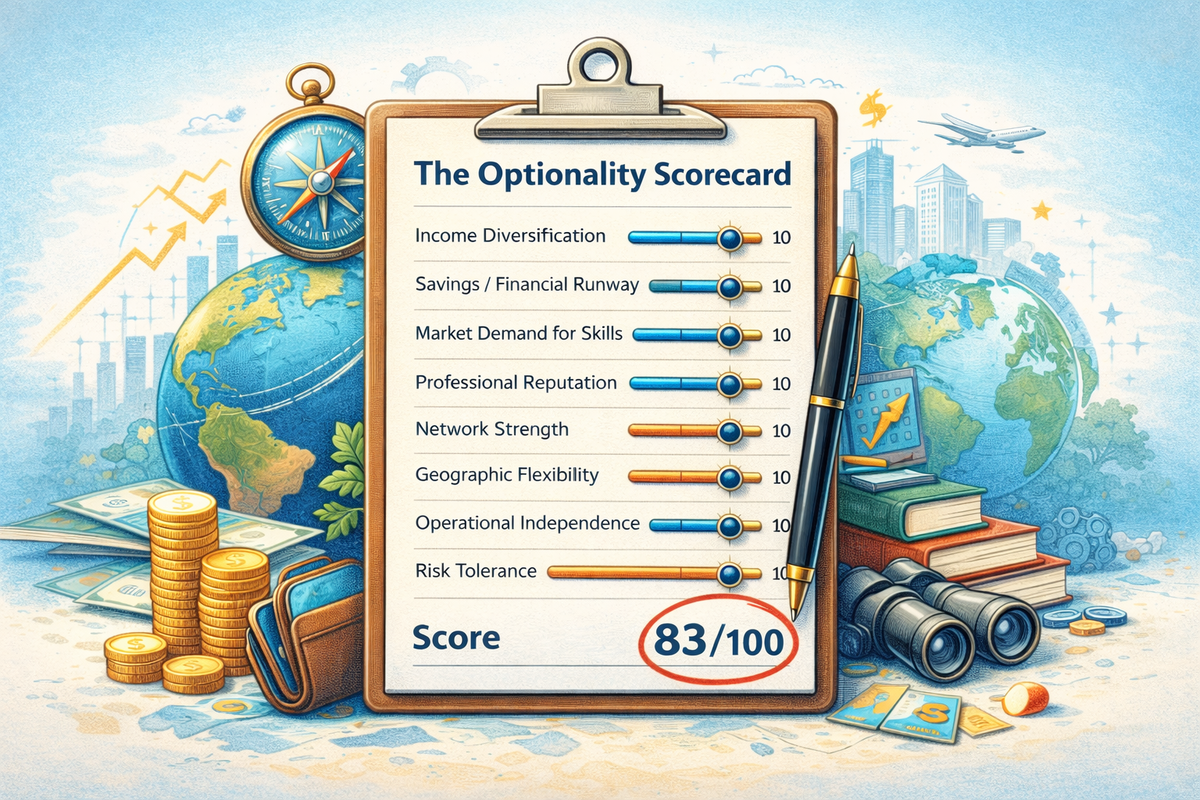
Measuring Your Readiness for an Independent Career
Download the Scorecard as an Excel Sheet at the end of this article!
Most professionals who pursue independent or fractional careers do so before they have built the conditions that make those careers viable. This framework provides a structured method for assessing where you are — and what to build next.
1. The Optionality Illusion
There is a consistent pattern in how professionals approach independent careers. The trigger is usually a period of frustration — a restructuring, a disappointing performance review, a promotion that does not materialise, or a prolonged experience of misalignment between the work and the professional's sense of where their capabilities should take them. In this state, the idea of independence — fractional work, advisory roles, a portfolio career — becomes appealing precisely because it represents an exit from the current situation rather than a carefully evaluated destination.
The problem is structural, not motivational. A professional who transitions to independent work without having built the underlying conditions for that work to succeed is not making a career move — they are making a financial bet against their own preparation. The conditions that make independent careers viable are specific: demonstrable external demand for your expertise, sufficient financial runway to absorb the income ramp, a professional network that generates work through relationships rather than cold outreach, and the operational infrastructure to deliver and get paid independently of an employer's systems.
Most professionals, when they honestly assess these conditions, find that some are strong and others are absent. This is not an argument against independence — it is an argument for sequencing. The Optionality Scorecard is a diagnostic, not a prescription. It identifies where you are relative to where the conditions for independence require you to be.
2. What Is Career Optionality?
|
|
Definition Career optionality is the ability to generate income and opportunities without depending on a single employer, geography, or professional identity. It is the accumulation of leverage, reputation, relationships, and financial resilience that allows a professional to choose how, where, and with whom they work. |
Optionality is not the same as independence. Independence is a career state; optionality is the set of conditions that make independence viable — and that improve outcomes even for professionals who choose to remain employed.
The value of optionality operates across four dimensions:
- Negotiating power: A professional with genuine alternatives does not accept the first offer. They negotiate salary, terms, scope, and flexibility from a position of demonstrated options rather than perceived necessity.
- Financial resilience: Diversified income sources and adequate savings reduce the vulnerability that single-employer dependence creates. An unexpected redundancy is a career disruption; with optionality built, it is a manageable transition.
- Lifestyle flexibility: Location independence, flexible time allocation, and the ability to choose the type and scale of work produce a quality-of-life compound that linear employment rarely allows.
- Long-term career security: In an era of accelerating skill obsolescence, external reputation and demonstrated market demand are more durable foundations for career security than tenure or internal seniority.
3. Introducing the Optionality Scorecard
The Optionality Scorecard evaluates readiness for an independent or fractional career across ten structural dimensions. Each dimension represents a distinct component of career optionality — no single dimension is sufficient on its own, and weakness in one can undermine strength in others.
The framework is diagnostic, not evaluative. A low score on any dimension is information about where to direct effort, not a judgement on professional capability. The purpose of the scorecard is to replace the vague question "am I ready?" with a specific, actionable map of what to build.
|
|
How to Use the Scorecard Score yourself honestly on each of the ten dimensions from 0 to 10 using the scoring guide provided. Total your scores (maximum: 100). Use the interpretation table to identify your current optionality tier and the section on score improvement to prioritise where to focus in the next 6–18 months. |
4. The Ten Optionality Dimensions
1. Income Diversification
Single-source income is the defining characteristic of a dependent career. Diversification is not simply having a side project — it is the structural distribution of income across sources that do not all fail simultaneously. A professional whose income includes an employment salary, a quarterly advisory retainer, and a small amount of content or course revenue is structurally more resilient than one earning the same total from one source.
How to assess it: Count your income sources. What percentage of your total income last year came from your primary employer? Below 80% suggests early diversification. Below 50% suggests meaningful independence. Score 0 if you have no independent income; score 10 if no single source exceeds 50% of total income.
2. Financial Runway
Runway is the number of months you can sustain your current standard of living if your primary income stops without warning today. It is the most operationally critical dimension for anyone considering a transition. The income ramp for independent work is real: most professionals take 6–18 months to build a stable fractional or advisory portfolio. Without runway to absorb that ramp, a transition becomes a financial emergency.
How to assess it: Divide your liquid savings by your monthly essential expenses. Under 3 months: score 0–2. 3–6 months: 3–5. 6–12 months: 6–7. 12–24 months: 8–9. Over 24 months: 10.
3. Market Demand for Skills
The central question for any independent professional is whether the market — independent of your employer — will pay for what you know. Many professionals have skills that are deeply valued inside their current organisation but have no external market. Domain expertise that transfers is specific, demonstrated, and expressed in the language of outcomes rather than job functions.
How to assess it: Have you been approached by external organisations about your expertise in the last 12 months, unsolicited? Do people in your network refer you to others as an expert in a specific area? Have you been paid, or asked to quote, for independent work? Genuine external demand is the signal.
4. Professional Reputation
Reputation is the mechanism by which expertise creates inbound demand. In independent careers, reputation does the work that a job title does in corporate careers — it signals credibility and reduces the buyer's assessment cost. Reputation is built through visible evidence: published thinking, demonstrated outcomes across multiple organisations, referrals from credible sources.
How to assess it: Would a founder or CEO who has never met you find evidence of your expertise through a simple search? Do you have case studies, published content, or public endorsements that communicate your specific capabilities? Score 0 if you have no external visibility; score 10 if you have clear domain authority and consistent inbound.
5. Network Strength
For fractional and advisory work, the professional network is the primary distribution channel. Cold outreach has a low success rate in professional services because these arrangements require trust that has not been established. Work comes from people who have seen your capabilities, or who know someone who has. A strong network for independent work includes former colleagues who have founded companies, investors who see relevant problems across portfolios, and domain peers who refer work they cannot take.
How to assess it: Think of your last three professional opportunities. Where did they come from? If all came through your current employer or internal promotions, your independent network is underdeveloped. If any came from external referrals, unsolicited approaches, or former colleague introductions, it is beginning to function.
6. Geographic Flexibility
Location independence multiplies optionality by expanding the accessible client base, reducing cost structures, and removing constraints imposed by proximity to one employer. A professional who can work from anywhere can serve clients across time zones, access lower cost-of-living markets, and is not subject to one city's job market if primary income is disrupted.
How to assess it: Does your work require physical presence? Could your primary income source continue if you relocated domestically or internationally? Have you structured your life such that a geographic transition would be operationally feasible within 6 months? Score based on both technical feasibility and actual flexibility.
7. Operational Independence
Employment removes most of the administrative infrastructure of professional work: contracts, invoicing, tax compliance, client management, and delivery governance are handled by the organisation. Independent professionals must build this infrastructure from scratch. Many experienced professionals significantly underestimate how much of their current operational capacity belongs to their employer rather than to them personally.
How to assess it: Have you independently scoped, contracted, delivered, and invoiced for professional work outside of employment? Have you managed a client relationship from beginning to end without institutional support? Score 0 if you have no independent operating experience; score 10 if you have an active, established practice.
8. AI and Technology Leverage
The ability to use AI tools to compress execution time is an optionality multiplier. Fractional professionals who leverage AI effectively can serve more clients at higher quality within the same time envelope — improving both the economics and the capacity of the independent model. This dimension is not about technical expertise; it is about practical integration of AI into core professional workflows.
How to assess it: Which AI tools do you use regularly in your core work? Have they materially reduced your time on execution tasks? Can you produce research, analysis, documents, or client deliverables significantly faster than you could 18 months ago? Score based on actual, demonstrated time leverage — not familiarity.
9. Negotiating Power
Negotiating power is the most direct expression of accumulated optionality. A professional with genuine alternatives — other offers, independent income, financial runway — enters every professional negotiation from a position of structural strength. This changes the terms available in employment negotiations, client retainer structures, and engagement scope. Negotiating power is both an outcome of optionality and a signal of how much you have built.
How to assess it: In your last salary or engagement negotiation, did you have a genuine alternative you would have taken? Have you declined professional opportunities in the last 12 months because they did not meet your terms? Score 0 if you feel compelled to accept available offers; score 10 if you regularly set your own terms.
10. Personal Risk Tolerance
Risk tolerance is not the same as recklessness. It is the honest assessment of whether you have the psychological and financial capacity to absorb the income variability, client uncertainty, and structural ambiguity of independent work. Some professionals have high competence and low risk tolerance — for them, building optionality while remaining employed is a better strategy than a sudden transition. This dimension calibrates the pace of the transition, not the destination.
How to assess it: How did you respond to previous periods of income uncertainty or professional ambiguity? Have you managed client or project risk before? Do you have the household financial structure that allows for income variability? Score honestly — overestimating risk tolerance is the most common error in independent career planning.
5. The Optionality Scorecard
Table 1: The Optionality Scorecard — Score Yourself Across All Ten Dimensions
|
Dimension |
Why It Matters |
Scoring Guide (0–10) |
Score 0–3 |
Score 8–10 |
|
1. Income Diversification |
Single-source income is structurally fragile. Diversification measures how independent your total income is from one employer. |
0–3: 100% one employer. 4–6: Side income <20%. 7–9: Multiple streams >30%. 10: No single source >50%. |
Entirely dependent on employer; no independent income |
3+ income streams; no single source exceeds 50% |
|
2. Financial Runway |
How long can you sustain your current lifestyle if your primary income stops tomorrow? Runway is the operational foundation of any independent path. |
0–3: Under 3 months. 4–5: 3–6 months. 6–7: 6–12 months. 8–9: 12–24 months. 10: 24+ months. |
Under 3 months of expenses saved; transition not viable |
24+ months runway; transition low-risk financially |
|
3. Market Demand for Skills |
Do companies and clients actively pay for what you know, independent of your job title? Demand must exist outside your current employer. |
0–3: Skills only valued inside current org. 4–6: Some external demand. 7–9: Repeated inbound interest. 10: Clear, demonstrated external market. |
Skills are employer-specific; no independent demand signal |
Consistent inbound from multiple external sources |
|
4. Professional Reputation |
Is there a body of evidence — visible to the market — that demonstrates your competence? Reputation is the currency of independent careers. |
0–3: No external visibility. 4–5: Recognised internally. 6–7: Known in sector. 8–9: Published/cited/referred. 10: Clear domain authority. |
No external visibility; known only inside current org |
Demonstrable domain authority; referral-based demand |
|
5. Network Strength |
A strong, active professional network is the primary distribution channel for fractional and advisory work. Quality matters more than quantity. |
0–3: Mostly internal. 4–5: Sector peers only. 6–7: Active external relationships. 8–9: Investors/founders included. 10: Multi-market, multi-sector network. |
Relationships limited to current or recent employers |
Multi-sector network; includes founders, investors, peers |
|
6. Geographic Flexibility |
Location independence multiplies income options by expanding the accessible client base and removing residential cost constraints. |
0–3: Tied to one city/country. 4–5: Could move domestically. 6–7: Open to relocation with planning. 8–9: Remote-ready, internationally. 10: Fully location-independent income. |
Income and lifestyle fully tied to one location |
Fully location-independent; income portable across markets |
|
7. Operational Independence |
Can you manage your own client relationships, contracts, invoicing, and delivery infrastructure? Employment removes these; independence requires them. |
0–3: No independent operating experience. 4–5: Managed small projects. 6–7: Managed consulting work. 8–9: Active independent engagements. 10: Established practice. |
No experience managing independent work or client delivery |
Established operating infrastructure; active engagements |
|
8. AI and Technology Leverage |
Professionals who use AI to compress execution time can serve more clients at higher quality. Technology fluency is an optionality multiplier. |
0–3: Minimal tool adoption. 4–5: Basic AI usage. 6–7: Integrated into workflow. 8–9: Significant time leverage. 10: AI core to delivery model. |
Not using AI tools; full manual execution on all tasks |
AI deeply integrated; produces materially more per hour |
|
9. Negotiating Power |
Do you have genuine alternatives that affect how employers and clients treat you? Negotiating power is a function of demonstrated optionality. |
0–3: No alternatives; risk of taking any offer. 4–5: Limited alternatives. 6–7: Could find comparable role. 8–9: Have declined offers recently. 10: Can set own terms. |
No real alternatives; accept offered terms consistently |
Regularly declines unsuitable opportunities; sets own terms |
|
10. Risk Tolerance |
Independent careers involve income variability, client churn, and ambiguity. Your capacity to absorb and manage this risk shapes which pathway is appropriate. |
0–3: Very low tolerance; requires stability. 4–5: Moderate; prefers predictability. 6–7: Comfortable with variability. 8–9: Has navigated income uncertainty. 10: Actively prefers independent risk profile. |
Requires stable, predictable income; independent path premature |
Comfortable with variability; has managed uncertainty well |
How to use: Score each dimension honestly from 0 to 10 using the scoring guide. Total your scores. Maximum possible: 100. Use the interpretation table below to assess your current optionality tier.
6. Interpreting Your Score
Table 2: Score Interpretation — The Four Optionality Tiers
|
Level |
Score |
Category |
What It Means |
|
Low |
0–24 |
Dependent Career |
Significant structural dependence on current employer. Transitioning now carries high risk of income disruption. Priority: financial runway and first external income signal. |
|
Developing |
25–49 |
Building Optionality |
Early-stage optionality is forming. Some dimensions are strong but others represent genuine risk. Continue building in parallel with employment before testing independent income. |
|
High |
50–69 |
Ready to Experiment |
Optionality exists in meaningful form. First fractional or advisory engagements are appropriate now, alongside employment. Transition becomes viable as income signals strengthen. |
|
Full |
70–100 |
Independent Career Viable |
Independence is structurally supportable. Multiple income streams, demonstrated demand, and financial resilience make a full transition from employment a rational rather than impulsive choice. |
Two important caveats on score interpretation. First, the total score is less informative than the pattern of dimension scores. A professional with a total of 55 — apparently in the High Optionality range — but with scores of 2 on Financial Runway and 1 on Operational Independence has a critical gap that makes transition premature regardless of the aggregate. Minimum thresholds matter: a score below 4 on Runway or Market Demand represents a structural blocker that should be resolved before building other dimensions.
Second, optionality is not a state to achieve and then maintain passively. It degrades if not actively developed. A professional who stops publishing, stops building their network, and stops adding new clients to their advisory portfolio will find their scorecard declining within 18–24 months.
7. How to Increase Your Optionality Score
Each dimension has specific, actionable interventions. The most efficient path is to identify the two or three dimensions where your score is lowest and has the highest leverage — typically Reputation, Market Demand, and Financial Runway — and address those first, in parallel with employment.
Build Professional Reputation (Dimension 4)
- Publish one analytical piece per month in your domain — not personal opinion, but structured thinking that demonstrates how you approach problems. The medium is secondary to the quality and consistency.
- Build a body of public work over 12–18 months. A professional with 15 published pieces on a specific topic has created a reputation asset that no amount of internal seniority can replicate externally.
- Contribute to sector communities, conferences, and networks where potential clients and referrers are active.
Generate the First External Demand Signal (Dimension 3)
- Identify one person in your network who would benefit from your specific expertise and have a structured conversation about their problem — not a pitch, a demonstration.
- Take on one small advisory arrangement at a modest fee. The purpose is not income; it is the evidence that the market will pay, which changes the internal psychology of the transition.
Build Financial Runway (Dimension 2)
- Calculate your monthly essential expenses with precision. Identify the target runway (recommend: 12 months minimum before transitioning) and build a monthly savings plan that gets there within a defined timeline.
- Runway is a non-negotiable foundation. It should be built before, not during, the transition to independence.
Activate and Expand the Network (Dimension 5)
- Map your existing network by category. Identify the gaps — most professionals are well-connected to former colleagues but poorly connected to founders, investors, and cross-sector operators.
- Invest in one meaningful, outbound connection per week — not solicitation, but genuinely useful engagement. Network compounding takes 12–24 months to produce reliable inbound flow.
Develop AI Leverage (Dimension 8)
- Identify the two or three AI tools most directly relevant to your domain and invest in developing working proficiency — not surface familiarity. Measure the actual time saving per week and compoud it into capacity.
8. Optionality as a Long-Term System
The most useful reframe for professionals approaching this framework is to treat optionality as an accumulation system rather than a threshold. There is no single moment at which a professional becomes ready. Each week of published thinking, each new external relationship, each month of saved runway, each paid advisory conversation adds incrementally to the stock of optionality.
This system view has a practical implication: optionality-building activity should not wait until a transition is planned. It should be part of ongoing professional practice regardless of employment status. A professional with strong employment who consistently builds reputation, network, and external demand is simultaneously increasing the quality of their employment terms and their independence from any single employer. The two are not in tension.
|
|
The Compounding Principle A professional who scores 45 today and adds 3–4 points per quarter through consistent, deliberate activity will reach 70+ within 18 months — moving from Developing Optionality to Full Optionality without a disruptive transition. The compounding of small, sustained inputs is the mechanism of career optionality, not a single transformative event. |
The dimensions of the scorecard interact. A strong reputation (Dimension 4) generates inbound demand (Dimension 3), which creates real negotiating power (Dimension 9). A strong network (Dimension 5) is the distribution infrastructure for advisory work (Dimension 7). Financial runway (Dimension 2) reduces pressure in client negotiations and allows deliberate rather than desperate acceptance of engagements. Building any one dimension creates momentum in adjacent ones.
9. Conclusion: Independence Is a Destination, Not a Departure
The professionals who successfully build independent careers do not, in most cases, make a dramatic break from employment. They build systematically, in parallel with employment, until the conditions for independence are present — and then they transition when the transition is a rational choice rather than a reaction to circumstance.
The Optionality Scorecard is designed to support that process. It converts an abstract ambition — career independence — into ten specific, measurable conditions that can be evaluated, tracked, and improved over time. The total score matters less than the honest pattern of dimension scores and the identification of the blockers that represent genuine risk.
Score yourself now. Identify the two or three dimensions where your score is lowest and your leverage is highest. Build those, in the next 12 months, while continuing to perform well in your current role. Score yourself again in 12 months. The gap between those two assessments is the distance you have moved toward a career that does not depend on a single employer's decisions.
That is what optionality means in practice. Not the freedom from work, but the freedom to choose its terms.
About the Optionality Scorecard
The Optionality Scorecard is an original Optionality Lab diagnostic framework developed from primary research on career transitions, fractional executive markets, and independent professional practice. It draws conceptually on research from the World Economic Forum Future of Jobs Report 2025, McKinsey Global Institute research on independent work and skill-shift, and the Frak State of Fractional Industry Report 2024.
Sources: WEF Future of Jobs 2025 (weforum.org) · McKinsey Independent Work (mckinsey.com) · Frak Industry Report 2024 · Vendux Fractional Data 2024
Disclaimer: This framework is for informational and self-assessment purposes only. It does not constitute career, financial, or legal advice. Individual circumstances vary significantly.