Fractional Professional Toolkit: The Commercial Documents Every Independent Needs
There is a persistent myth in the fractional work conversation: that expertise sells itself. That fifteen years of senior experience in a function is sufficient to walk into client conversations, command serious rates, and protect yourself when engagements go sideways.
The data suggests otherwise. The most common failure mode for professionals moving into fractional work is not competence — it is commercial infrastructure. Underpricing in early engagements anchors rate expectations that are difficult to correct later. Proposals written without a clear structure sell time rather than outcomes, which attracts the wrong clients at the wrong price. Scope creep, the defining hazard of retainer work, almost always traces back to a single document problem: nobody defined what out of scope meant before the engagement started.
These are not expertise failures. They are infrastructure failures. And they are almost entirely preventable.
Why the infrastructure gap exists
The corporate career does not prepare professionals for this. In a senior employed role, commercial infrastructure is institutional — the firm sets rates, legal handles contracts, finance invoices. The professional delivers the work. When that same professional goes fractional, they inherit all of those functions simultaneously, usually without having watched them operate up close.
The result is improvisation under pressure. A first client conversation happens before there is a rate card. A proposal gets drafted from scratch the night before it needs to go out. A scope of work gets handshake-agreed rather than documented because the relationship feels solid and nobody wants to introduce friction.
Each of these decisions is individually understandable. Collectively they create the conditions for the three outcomes that most damage early fractional careers: undercharging, overdelivering, and disputes that could have been avoided.
What the toolkit covers
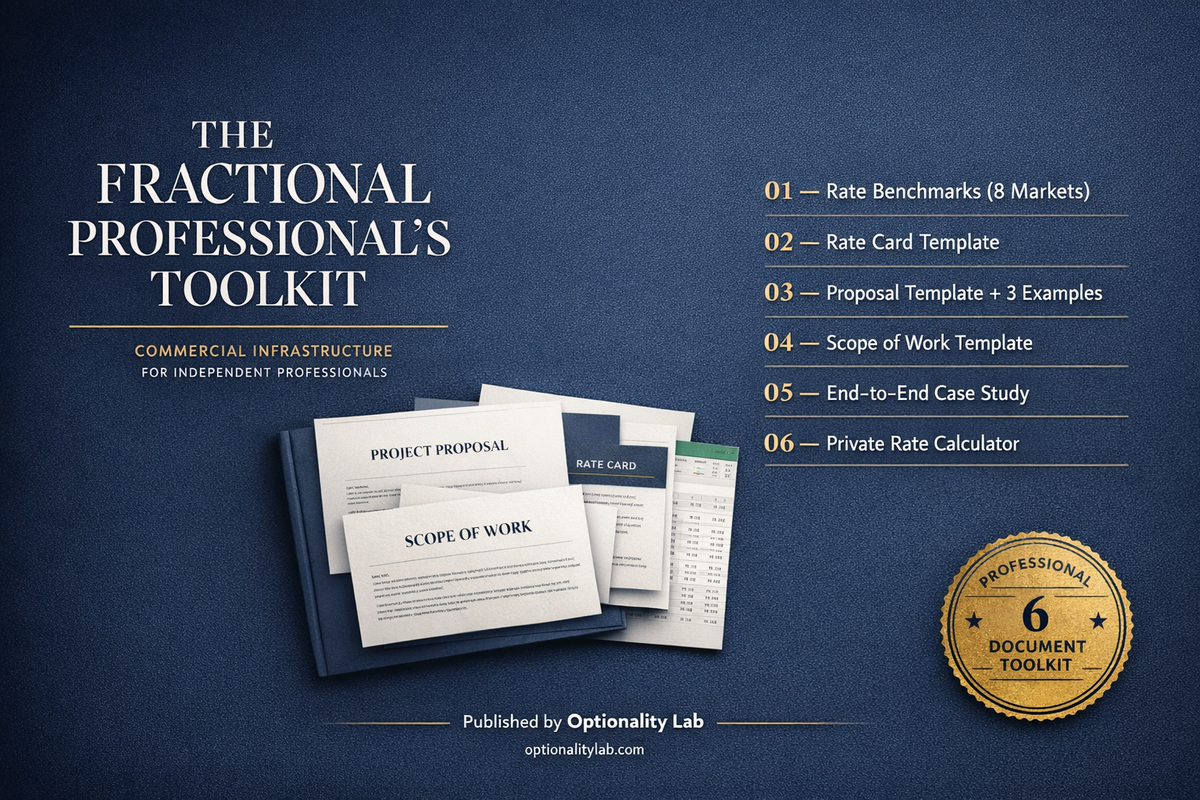
The Fractional Professional's Toolkit is a six-document commercial pack built around that gap. It is worth being specific about what each piece is actually solving.
The rate benchmark document addresses what is arguably the hardest single question in fractional work: what is the right number. Markets have real ranges — the document covers eight geographies in local currency — but geography is less important than most people assume. Client type is the bigger variable. A PE-backed company and a seed-stage startup represent structurally different risk profiles, different budget authority, and different rate expectations. Conflating them is one of the most common early pricing mistakes.
The rate card template solves a positioning problem as much as a document problem. Most fractional professionals either have no rate card or send something that reads like a freelance services menu. The framing matters: a rate card that leads with your terms and your tiers signals a different kind of professional than one that opens with an apology for the rates. Confidence in commercial documents is legible to clients before any conversation happens.
The proposal template and three worked examples — a fractional CMO at seed stage, a fractional CFO at Series B, a fractional COO in a PE-backed business — exist because the proposal is where most early fractional engagements get structurally wrong. A proposal that sells outputs will be held to outputs. A proposal that sells outcomes creates a different kind of accountability, one that is easier to demonstrate and easier to renew. The worked examples show the structure in context rather than in the abstract.
The scope of work template is the document with the highest financial leverage of anything in the pack. Scope creep is not usually malicious — it is the natural behaviour of a client who finds the relationship valuable and wants more of it. The SOW is not a defensive document; it is a commercial one. It defines the boundary that makes upsells possible. Without it, additional work just becomes expectation.
The end-to-end case study — a fractional CMO engagement from first contact to renewal, 34 qualified leads and £148K in pipeline across 90 days — exists because sequencing matters more than most people realise. When does the rate card go out relative to the discovery call? How does the proposal reference the SOW? When and how does the renewal conversation happen? These questions do not have obvious answers if you have never run the full cycle before. Seeing it mapped end-to-end is a different kind of learning than reading individual templates.
The rate calculator addresses the utilisation problem that most professionals underestimate when they model fractional income. At 60% utilisation across 220 working days, effective billable days are around 130. The rate required to hit a given income target at 130 billable days is materially higher than the number most people initially put in front of clients — and knowing that number before the first client conversation changes the negotiation entirely.
The broader point
The fractional market has grown significantly — estimates suggest the number of fractional leaders doubled between 2022 and 2024, and the structural drivers behind that growth, AI compressing the value of pure execution, companies separating strategic leadership from full-time headcount, are not temporary. More senior professionals will move in this direction.
The ones who build durable practices will not necessarily be the most experienced. They will be the ones who treat the commercial side of independent work with the same rigour they brought to their functional expertise. Infrastructure built early compounds. Habits formed in the first two engagements tend to persist.
The toolkit is a starting point for that infrastructure. Not a strategy guide — that is a different conversation — but the practical layer underneath it.
Where to get it
The Fractional Professional's Toolkit is available at fractional.optionalitylab.com — $15, instant download after purchase.
Optionality Lab publishes frameworks, research and tools for mid-career professionals building independent income, fractional careers, and long-term flexibility. Browse the full library at optionalitylab.com.